
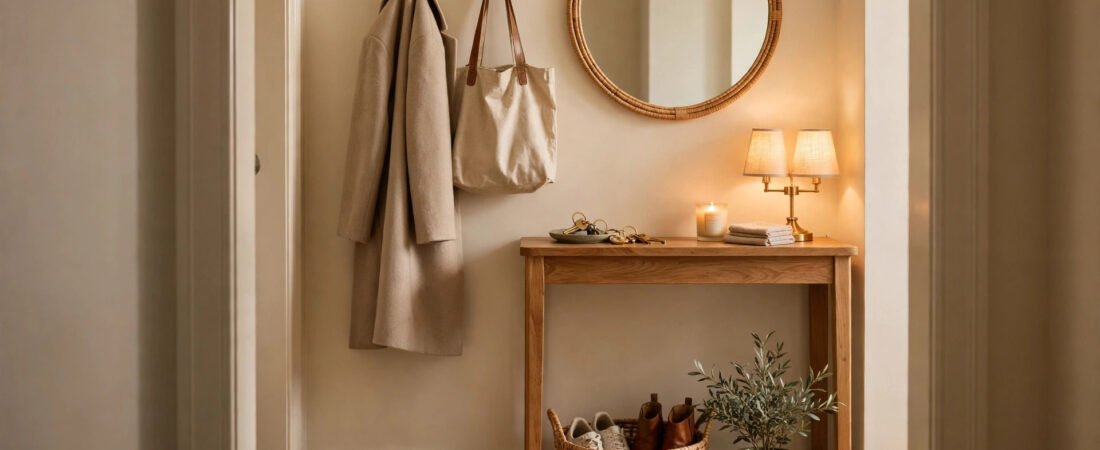
Your entryway is the first thing you see when you walk through the door — and in an apartment, it is often the smallest, most awkward space of all. A dark corner by the front door. A narrow strip of wall between the hallway and the living room. Barely enough room to kick off your shoes, let alone make a statement.
But here is the good news: you do not need square footage to create a welcoming entrance. With the right small entryway decor ideas for apartments, even a two-metre-wide nook can feel intentional, organised, and genuinely inviting. The trick is to think vertically, choose furniture that earns its keep, and pick decor that does double duty — every single piece should look good and work hard.
This guide walks you through 13 renter-friendly, budget-conscious ideas to transform that forgotten strip by your front door into a space you actually love coming home to.
1. Float a Narrow Console Table Against the Wall
The classic entryway piece is a console table, and it works in apartments too — you just need the slim kind. Look for tables that are 20 to 30 centimetres deep; anything chunkier will eat into your walkway. A simple wooden console, or even an IKEA LACK wall shelf mounted at console height, gives you a landing zone for keys, post, and a small lamp without blocking the door swing.
Style it in threes: a small tray for keys, something vertical like a vase with branches or a stack of two books, and one soft element such as a candle or a small plant. If the table wobbles on uneven flooring, a felt pad under one leg fixes it in seconds. This single addition immediately makes an entryway feel “done” rather than accidental.
2. Hang a Statement Mirror to Double the Space
If you can only make one change to your entryway, make it a mirror. A large mirror reflects light and creates the illusion of depth, which is pure magic in a cramped hallway. Round mirrors soften boxy corners; arched mirrors add architectural interest without any renovation.
Hang it at eye level (around 150 cm from the floor to the centre of the mirror) and keep it proportional — roughly two-thirds the width of whatever sits beneath it. If you are renting and drilling is off-limits, heavy-duty Command hooks hold mirrors up to several kilos, and most landlords will not object to the small nail holes a picture hook leaves anyway. For more damage-free hanging tricks, see our guide on how to hang gallery walls without nails.
3. Add Wall Hooks Instead of a Bulky Coat Stand
A freestanding coat rack eats floor space you do not have. Wall-mounted hooks do the same job on zero footprint. A row of three to five hooks at different heights handles coats, bags, dog leads, and scarves while keeping the floor clear.
Choose hooks with a bit of style — matte black, brushed brass, or oak peg rails all look intentional rather than utilitarian. For renters, no-drill adhesive hooks or over-the-door hook racks are brilliant. Pro tip: dedicate one hook to a reusable shopping bag and another to your most-used jacket, so grabbing them on the way out becomes automatic.
4. Define the Zone with a Runner Rug
In open-plan apartments, the entryway often bleeds straight into the living room. A runner rug draws a visual boundary that says “this is the entrance” without building a single wall. It also protects your flooring from wet shoes and adds warmth the moment you step inside.
Pick a low-pile, washable runner — indoor/outdoor rugs in a flat weave are practically indestructible and handle muddy boots gracefully. Dark patterns hide dirt between washes, which is why vintage-style or geometric prints are so popular in entryways. Make sure the runner is long enough that your front door clears it when it swings open; there is nothing worse than a rug that bunches every time someone walks in.
5. Use a Wall-Mounted Folding Shelf as a Mini Drop Zone
When there is genuinely no room for a console table, go vertical. A small wall-mounted shelf — or better yet, a drop-leaf folding shelf — creates a landing pad for keys, sunglasses, and hand sanitiser on about 30 centimetres of wall.
Mount it at about 100 to 110 cm high so you can toss your keys without looking. A folding design can be flipped down when guests arrive or folded up to keep the hallway extra clear. Pair it with a small lidded box or basket on the shelf to corral loose change and receipts. This is one of the cheapest upgrades in this list — a basic wooden shelf plus two brackets costs less than a takeaway dinner.
6. Bring in a Bench with Hidden Storage
A slim storage bench is the multitasker of entryway furniture: seating for pulling on shoes, hidden storage for the clutter, and a styling surface on top. In a small apartment entryway, a 60 to 90 cm bench tucked against the wall hits the sweet spot.
Look for benches with a hinged lid or fabric cubes inside — they swallow shoes, hats, gloves, and the reusable bags you keep forgetting. Add a cushion on top for comfort and a throw for texture, and the bench doubles as decor. If your entryway is truly tiny, a wall-mounted flip-down bench gives you seating only when you need it.
7. Light It Like You Mean It
Hallway entryways are notoriously dark — no windows, one sad ceiling bulb. Lighting transforms the mood instantly and makes the space feel larger and more welcoming. Since rewiring is out for renters, go for plug-in and battery options.
A small table lamp on your console table creates a warm pool of light at eye level, which is far more flattering than overhead glare. Plug-in wall sconces with cord covers look hardwired without an electrician. Battery-operated LED picture lights above a mirror or art add a gallery feel, and a motion-sensor nightlight near the floor means you never fumble for a switch with your hands full. Warm white bulbs (2700K) keep the space feeling cosy rather than clinical.
8. Add Greenery with Low-Maintenance Plants
Plants make any entryway feel alive and cared for, but a dark hallway is no place for a fussy fiddle-leaf fig. Choose survivors: snake plants, pothos, and ZZ plants tolerate low light and irregular watering, and they look sculptural in a simple pot.
No natural light at all? High-quality faux plants have come a long way. Check our roundup of the best artificial plants that look real for options that fool even seasoned plant people. A trailing pothos (real or faux) draped from a high shelf draws the eye upward, making ceilings feel taller. One plant is a nice touch; three at staggered heights is a styling moment.
9. Create a Gallery Wall in Miniature
Who says gallery walls are only for living rooms? A tight cluster of three to five frames above a console table or along the stair-side wall turns dead entryway space into a personal gallery. Because the area is small, keep the arrangement tight — frames spaced 5 to 8 cm apart read as one composition rather than scattered clutter.
Mix art prints with personal photos, a small mirror, and even a woven wall hanging for texture. Stick to two or three frame finishes for cohesion. Renters can use adhesive picture-hanging strips rated for the frame weight, and lightweight art in plastic frames stays put easily. A miniature gallery wall is also the fastest way to make a rental feel like your home rather than a temporary stop.
10. Install Peel-and-Stick Wallpaper on One Wall
Nothing transforms a boring entryway faster than pattern. Peel-and-stick wallpaper is the renter’s secret weapon: it goes up in an afternoon, peels off cleanly when you move, and comes in thousands of designs. One accent wall — or even just the wall behind your console table — is enough in a small space.
Bold choices pay off here because the area is tiny: a dramatic botanical print, a classic stripe, or a textured grasscloth-look can handle the visual weight. In narrow hallways, vertical stripes or patterns that draw the eye up make the space feel taller. Measure twice, order 10 percent extra for pattern matching, and use a smoothing tool to chase out bubbles as you go.
11. Corral Clutter with Baskets and Trays
Entryways attract clutter like magnets: post piles up, shoes multiply, and sunglasses vanish. The fix is not more storage — it is assigned storage. A lidded basket under the console swallows shoes. A slim tray on top catches keys and wallets. A wall-mounted file sorter or magazine holder handles post before it migrates to the kitchen counter.
The rule that makes it work: everything gets a home, and homes get labels if you share the space. Natural materials like seagrass, rattan, and felt add warmth that plastic never will. Once the system is in place, a two-minute nightly reset keeps the entryway looking styled instead of chaotic.
12. Make It Smell Like Home
First impressions are not only visual. The scent that greets you at the door sets the emotional tone of your whole flat. A reed diffuser on the console table, a plug-in scent warmer, or simply a candle you light when you get home — all of them signal “someone who has their life together lives here.”
Stick to one signature scent for the entryway rather than layering competing fragrances. Fresh, clean notes like eucalyptus, citrus, or linen work beautifully in small spaces because they read as airy rather than heavy. Flameless options like reed diffusers are the safest bet if you are out all day. It is a small detail, but guests notice it within seconds — and so will you.
13. Personalise with One Unexpected Touch
The final layer is personality. After the practical pieces are in place, add one thing that is purely you: a vintage travel poster from a favourite trip, a quirky door mat with a witty message, a small framed quote, a bowl of collected shells, or a colourful stool that has no business being practical but makes you smile.
This is what separates a decorated entryway from a staged one. It does not have to be expensive or perfect — it has to feel like home. In a rental especially, these personal touches do heavy lifting: they are also the easiest things to pack up and take to your next place. For more rental-safe upgrades throughout your flat, browse our 17 renter-friendly decor updates that will not cost you your deposit.
FAQ
What is the best way to decorate a very small entryway in an apartment?
Start with the essentials: a mirror to bounce light, wall hooks to keep coats off the floor, and a slim console or floating shelf as a drop zone. These three pieces cover storage, light, and function on almost zero footprint. Then add one soft layer — a runner rug or a plant — and one personal touch like art or a scent diffuser. Done well, five thoughtful pieces beat fifteen random ones.
How can I make a small entryway look bigger?
Light colours, mirrors, and vertical lines are your best tools. A large mirror opposite or adjacent to the light source doubles perceived space. Keep furniture slim and leggy so you can see floor underneath it — visible floor tricks the eye into reading the room as larger. Declutter ruthlessly: visual noise shrinks a space faster than anything. For more tricks that work throughout your flat, see our guide on how to make a small apartment look bigger.
What should I put in an apartment entryway if I have no closet?
Create a closet substitute on the wall: a row of sturdy hooks for coats and bags, a slim shoe cabinet or lidded bench for footwear, and a small basket or tray for the everyday carry items (keys, wallet, sunglasses). A narrow wardrobe or armoire works if you have 40 to 60 cm of wall — choose one with doors so the clutter stays hidden and the entryway still looks tidy.
Are there renter-friendly entryway ideas that do not damage walls?
Absolutely. Adhesive hooks and picture-hanging strips handle most lightweight decor without a single hole. Over-the-door organisers add storage to the back of the front door. Peel-and-stick wallpaper transforms walls and removes cleanly. Freestanding pieces — a leaning mirror, a narrow console, a storage bench — need no wall attachment at all. And washable runner rugs define the space with zero installation.
How much does it cost to decorate a small apartment entryway?
Far less than you might think. A solid entryway refresh can cost under £100 or $100: a second-hand mirror (£20–30), a set of adhesive wall hooks (£10–15), a washable runner rug (£25–40), and a reed diffuser (£10–15). Shop your own home first — that basket in the bedroom or the tray on your dresser might be perfect for the entryway. Thrift stores and marketplace apps are goldmines for mirrors and small furniture at a fraction of retail prices.
A small apartment entryway is not a design problem to apologise for — it is an opportunity to show off how clever small-space living can be. The best small entryway decor ideas for apartments share one thing in common: every piece earns its place by being beautiful and useful. A mirror that doubles your light. Hooks that replace a coat closet. A bench that hides the shoe chaos.
Start with the two or three ideas that solve your biggest pain point — whether that is clutter, darkness, or a total lack of personality — and build from there. You will be amazed how different it feels to walk through your own front door when the first thing you see is a space that was designed on purpose. After all, the entryway is your home’s handshake: make it a firm, warm one.
External sources: Apartment Therapy — small entryway ideas · The Spruce — small entryway ideas