
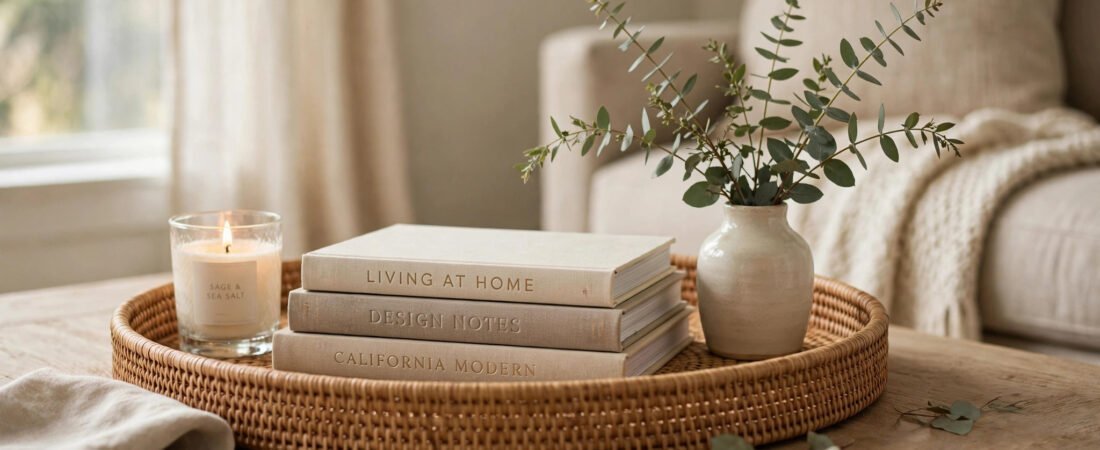
If you have ever wondered how to style a coffee table so it looks like the ones in interior design magazines, you are not alone. The coffee table is the centrepiece of most living rooms — it is the first thing guests notice and the surface you live with every single day. Yet most of us treat it as a dumping ground for remote controls, half-read magazines and yesterday’s post.
The good news is that designer-level coffee table styling is not about expensive objects. It is about a handful of repeatable tricks: grouping items in odd numbers, playing with height, and leaving enough empty space for the table to breathe. In this guide you will learn exactly how to style a coffee table step by step, with 15 simple tricks that work on any table shape, in any home, on any budget.
The 3-Piece Formula Designers Start With
Before the 15 tricks, here is the skeleton every beautiful coffee table follows. Interior designers rarely place objects randomly — they build around three layers:
- A base or corral — a tray, a runner, or a stack of books that gathers everything together and gives the arrangement a boundary.
- Something tall — a vase with stems, a candlestick, or a sculptural object that pulls the eye upward.
- Something low and personal — a candle, a small bowl, a decorative box — the item that makes it feel like a home, not a showroom.
Once you have those three layers, everything below is simply about refining them. If you remember nothing else from this article, remember: base, height, personality. Now let’s get into the details.
15 Tricks for Styling a Coffee Table Like a Designer
1. Start with a tray
A tray is the single most transformative coffee table accessory. It corrals smaller items into one visual group so they read as intentional rather than cluttered. The Spruce recommends choosing a tray that matches the rest of your decor — a neutral acrylic tray for a minimalist space, or something textured like braided rattan for a warmer look. As a rule of thumb, your tray should cover no more than one-third of the table’s surface, and its shape should contrast with the table: a round tray on a square table, a rectangular tray on a round table.
2. Stack your books, largest on the bottom
Coffee table books are the workhorses of styling. Stack two or three, largest at the bottom and smallest on top, like a pyramid. This instantly creates height without spending a penny. Rotate the stack 45 degrees so the spines face different directions — it looks curated rather than stiff. Pro tip: choose books whose covers echo your room’s colour palette, so the whole living room feels connected. If your room is full of neutral, cosy tones like the ones in our guide to 21 cosy living room ideas for small spaces, pick book covers in warm beiges and creams.
3. Add something living
Every designer coffee table has something alive on it — a small potted plant, a vase of fresh stems, even a sprig of eucalyptus from the garden. Greenery adds colour, texture and movement that no object can replicate. If you have low light, a small succulent or a dried arrangement works just as well and needs zero maintenance. Keep it modest in size: nothing so tall that it blocks the view of the television or the person sitting opposite you.
4. Light a candle (or three)
Candles add warmth and a sense of occasion, even on a Tuesday. Use an odd number — one large candle or a cluster of three small ones at different heights looks best. Always contain them: a glass hurricane, a wooden tray, or a ceramic dish protects the table from wax and makes the arrangement look finished. Scented candles in vanilla, sandalwood or fig double as room fragrance, which is half of what makes a living room feel cosy. For more on creating that warm glow throughout the room, see our guide to the best warm white LED bulbs for cosy lighting, and pair the candlelight with a well-placed floor lamp so the whole seating area glows.
5. Work in odd numbers
Groups of three or five look natural to the human eye; groups of two or four look staged. When you arrange objects, cluster them in threes: three candles, three small vases, or a book stack topped with one object. This one rule fixes more bad styling than any other.
6. Vary the heights
A flat arrangement looks flat. Aim for a zigzag of heights across the table: tall vase on one side, low tray in the middle, a medium book stack on the other. You can borrow height from books — place a short object on top of a book stack to lift it. Designers call this “creating a skyline”, and it is what separates a styled table from a table with stuff on it.
7. Mix your materials
Wood, glass, ceramic, metal, woven fibres — a mix of two to four materials adds richness. If everything on the table is the same finish, the arrangement looks dull. Try a wooden tray + glass vase + brass candlestick + linen coaster set. Natural materials are especially forgiving: rattan, stone and wood look good in almost any room.
8. Leave negative space
The most common beginner mistake is filling every centimetre. A styled coffee table needs breathing room — about one-third of the surface should stay empty. That empty space is what makes the styled sections look deliberate, and it keeps the table functional: you still need somewhere to put your cup of tea. If your living room is on the smaller side, breathing room matters even more; our guide on how to make a small apartment look bigger explains why visual space reads as physical space.
9. Add a decorative box or bowl
A pretty box hides the unpretty stuff — remote controls, chargers, reading glasses — while looking like decor. A shallow bowl works the same way and, according to designers quoted by The List, it is one of the most versatile objects you can own: fill it with something personal, like printed photos, postcards from family travels, or even your kids’ Lego creations, and it becomes a conversation piece.
10. Include something personal
The difference between a showroom table and a home is personality. One framed photo, a souvenir from a trip, a handmade pottery piece — one personal object is enough. More than one or two and the table starts to feel like a shelf. This is also the item guests will ask about, which makes it worth choosing carefully.
11. Style the lower shelf too
If your coffee table has a lower tier or shelf, do not ignore it — but do not overthink it either. Keep the lower level simpler than the top: a row of books, a basket, a folded throw. The goal is to echo the top without copying it, so the whole piece feels cohesive from every angle.
12. Anchor with a rug
A coffee table never looks its best floating on bare floor. The right rug anchors the whole seating area and gives your styling a finished backdrop. If you are not sure what size to buy, our guide to the best rugs for small living rooms covers sizing rules that work in any space.
13. Change it with the seasons
You do not need a full restyle four times a year — just swap one or two elements. A bowl of pinecones in winter, a vase of tulips in spring, a shell or piece of driftwood in summer. These tiny seasonal swaps keep the table feeling fresh and give you an excuse to rearrange, which is half the fun.
14. Keep a consistent colour palette
Pick two or three colours and repeat them across the objects. The easiest method: look at your sofa cushions or wall art and pull colours from there. When every object shares a palette, even a random collection of things looks intentional. Neutrals (cream, beige, wood tones, black) are the safest starting point; add one accent colour for energy.
15. Edit, then edit again
Style the table, step back, take a photo with your phone, and look at the photo instead of the table. Photos reveal clutter your eyes skip over. Remove one item — designers almost always remove something at the end. If the photo still looks busy, remove another. Less is almost always more.
Styling by Table Shape
The tricks above work everywhere, but a few shape-specific notes help:
– Rectangular tables: Divide the surface into three zones (left, centre, right) and style each as its own mini-arrangement. This is the easiest shape to style.
– Square tables: Split into four quadrants and place one group in each, or style the centre boldly and leave the corners empty.
– Round tables: Use triangular arrangements — three groups forming a triangle. Round trays and bowls echo the shape beautifully.
– Oval tables: Treat like a rectangle but soften everything: curves, round objects, no sharp corners.
Common Coffee Table Styling Mistakes
– Everything the same height. Flat arrangements look accidental. Vary it.
– Too many small items. Ten tiny objects read as clutter; three larger ones read as design.
– Ignoring scale. A tiny candle on a huge table looks lost; a giant vase on a small table overwhelms it. Match object size to table size.
– Forgetting function. If nobody can set down a mug, the styling has failed at its job.
– Matching sets. A matching tray-candle-vase set from one shop looks flat. Mix sources and eras for character.
FAQ
What are the essential items for styling a coffee table?
The essentials are a tray or book stack as a base, something tall like a vase with stems, and something low and personal like a candle or decorative bowl. With those three layers — base, height, personality — you can style any coffee table.
How many items should be on a coffee table?
Aim for 3 to 7 decorative objects, grouped in odd numbers, covering about two-thirds of the surface. Leave the remaining third empty so the table stays functional for drinks, snacks and feet-up evenings.
How do you style a coffee table on a budget?
Shop your own home first: stack books you already own, cut greenery from the garden, and repurpose a kitchen tray or a nice bowl. Thrift stores and pound shops are goldmines for vases and candlesticks. Styling is about arrangement, not spending.
Should a coffee table match the rest of the living room?
It should coordinate, not match. Repeat two or three colours from your sofa, rug or wall art across the tabletop objects so the room feels connected, but let the objects themselves be a mix of materials and styles for character.
How often should you restyle a coffee table?
A light refresh with the seasons — swapping one or two items — is plenty for most homes. Restyle fully only when the room itself changes, like a new sofa or a new rug, so the table keeps matching its surroundings.
Conclusion
Learning how to style a coffee table is really about learning five habits: start with a tray or books, add height with something tall, work in odd numbers, mix materials, and leave breathing room. Everything else — the seasonal swaps, the personal objects, the shape-specific layouts — is refinement.
The best part? You probably own everything you need already. Clear the clutter, pull out a tray, stack those books, add a candle and something green, and step back. Your living room’s centrepiece is about to look like it hired a designer — and all it cost you was twenty minutes.