
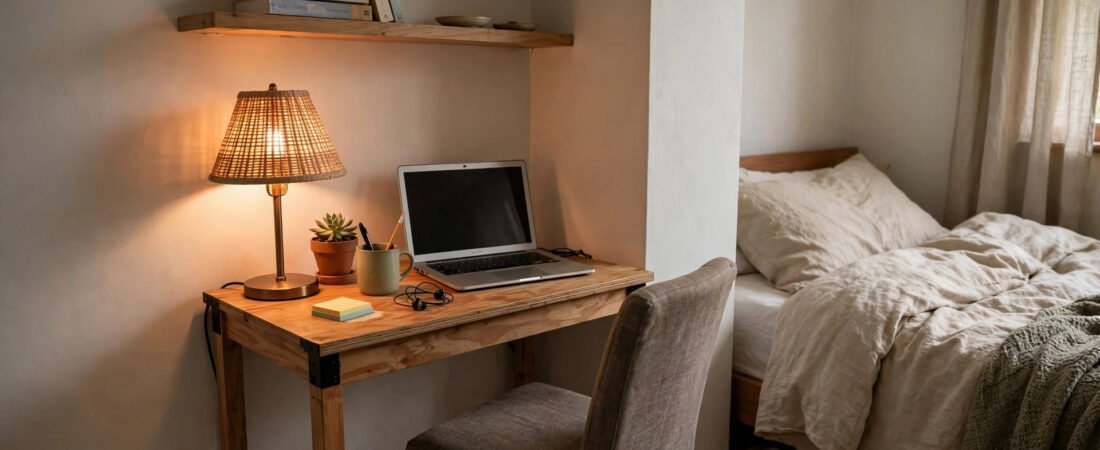
Working from home is no longer a rare perk — it is everyday life for millions of us. But not everyone has a spare room to turn into a Pinterest-perfect study. If you are carving out a workspace in a flat, a shared house, or a cosy family home, these small home office ideas on a budget prove you do not need much space or money to build somewhere you genuinely enjoy working.
Every idea below is evergreen, renter-friendly where it matters, and costed with rough real-world prices so you can plan your spend. Most of these setups come in well under £150 — many under £50 — and all of them prioritise the three things that actually make a small office work: a comfortable work surface, good lighting, and a place for everything to live.
1. Turn a Closet into a “Cloffice”
The classic budget move for a reason. Remove the closet doors (store them safely if you rent), add a simple desktop plank or a small desk inside, and you have a self-contained office that hides behind curtains or doors at the end of the day. A curtain on a tension rod makes a lovely soft “door” and costs a few pounds.
Paint the inside of the closet a lighter shade than the rest of the room — white or a pale sage — so it feels bright rather than cave-like. Add a strip of stick-on LED lighting under the shelf above, and you have task lighting sorted for almost nothing. Rough cost: £30–£80 for the curtain, LEDs and a desktop plank.
If closet space is already doing hard work in your home, take a look at our guide to small bedroom closet organization first — a tidy closet elsewhere makes it far easier to sacrifice one for office duty.
2. Squeeze a Corner Desk into an Unused Corner
Corners are the most wasted square footage in any home. A small corner desk, or even an L-shaped arrangement of two budget desks, fits neatly where two walls meet and gives you surprisingly generous work surface. Corner desks are some of the cheapest desks you can buy new, and second-hand ones are everywhere.
Place your chair facing into the corner so both walls can carry shelves and noticeboards. This layout works beautifully in bedrooms and living rooms because it tucks the office into a footprint barely bigger than a chair. Rough cost: £40–£90 for a basic corner desk.
3. Install a Wall-Mounted Drop-Leaf Desk
For the tightest spaces of all, a drop-leaf desk mounted to the wall folds flat when you are done working. IKEA’s BJURSTA wall-mounted drop-leaf table has been a small-space hero for years, but you can DIY one with a sturdy hinge bracket, a plank of wood, and a couple of wall plugs for under £30.
Mount it at standard desk height (about 73–76 cm), and add a floating shelf above for supplies. When folded down, the room gets its floor space back entirely — ideal for studio flats. Rough cost: £20–£60.
4. Claim the Under-Stairs Nook
That awkward triangle under the stairs is prime office real estate if you are lucky enough to have one. A slim desk or even a wall-mounted shelf as a work surface fits the low side, while the taller side takes your chair and a small storage unit.
Under-stairs spots are often the darkest corner of the house, so lighting matters here more than anywhere — a warm task lamp and reflective pale paint will stop it feeling gloomy. These nooks suit focused work brilliantly because they feel naturally enclosed. Rough cost: £40–£100.
5. Set Up a Bedroom-Corner Office That Doesn’t Feel Like an Office
Putting your office in the bedroom is practical, but nobody wants to feel like they sleep at their desk. The trick is visual zoning: a small rug under the desk, a room divider or tall plant beside it, and warm lighting that feels different from your overhead bedroom light.
Keep the desk small and choose one in a wood tone that matches your bedroom furniture so it reads as a side table rather than office equipment. Our roundup of cheap bedroom decor ideas has plenty of styling tricks that blend a workspace into a restful bedroom. Rough cost: £30–£80 on top of a desk you may already own.
6. Build Storage Upwards with Floating Shelves
In a small office, the walls are your storage unit. Floating shelves above and beside your desk hold books, boxes, plants, and supplies without touching a single centimetre of floor space. They also draw the eye upward, which makes the whole zone feel taller and more considered.
Our step-by-step guide to DIY floating shelves walks you through building your own for a fraction of the shop price — a pair of chunky wooden shelves typically costs under £25 in materials. Rough cost: £20–£50.
7. Master Cable Management for an Instantly Calmer Desk
Nothing makes a tiny workspace feel messier than a nest of cables. Cable management is the cheapest upgrade on this list and one of the most satisfying: a pack of adhesive cable clips, a cable sleeve, and a small box to hide your power strip costs under £10 total.
Route cables along the back edge of the desk, mount your power strip under the desktop, and coil excess length with reusable ties. The visual difference is enormous — a tidy desk makes even the smallest setup feel intentional. Rough cost: under £10.
8. Light It Like You Mean It: Small Home Office Ideas on a Budget for Lighting
Bad lighting is the number one reason small home offices feel depressing. Overhead fluorescents and a single dim bulb will drain your energy by mid-afternoon. The fix is layers: a warm desk lamp for task work, plus ambient light to lift the corners.
Floor lamps are brilliant in small offices because they add light without taking up desk space — see our guide to the best floor lamps for small spaces for space-saving styles. And swapping harsh bulbs for warm white LED bulbs (around 2700K) instantly makes any corner feel cosier. If your space is short on daylight, Houzz’s budget office guide also recommends repurposing furniture you already own before buying anything new — a philosophy that keeps costs near zero (Houzz: How to Set Up Your Home Office on Nearly Any Budget). Rough cost: £15–£40.
9. Use a Folding Desk That Disappears After Hours
If your office shares space with a dining table or living room, a folding desk is the answer. Folding desks open for the workday and collapse flat against the wall or into a cupboard at 6 pm, giving you a genuine work-life boundary in one piece of furniture.
Look for models with a built-in shelf so your monitor and supplies can stay put while folded — some clever designs keep everything in place. Rough cost: £35–£80.
10. Style a Pegboard Wall for Flexible Storage
Pegboards are the Swiss army knife of small office storage: infinitely rearrangeable, wall-mounted, and cheap. A painted pegboard above your desk holds headphones, notebooks, scissors, small baskets, and even a clock — everything visible and within reach.
Paint it the same colour as your wall for a seamless look, or a bold accent colour to make it a feature. Hooks and baskets cost pennies at pound shops and IKEA. Rough cost: £15–£35.
11. Borrow Space from the Hallway or Landing
Hallways and landings are often wide enough for a slim console-depth desk (30–40 cm deep is plenty for a laptop). This is a great option if every room is taken but your hallway has a dead stretch of wall near a socket.
Add a small rug to define the zone, a wall shelf above for supplies, and a decent chair that tucks fully under the desk. Because it is a walkway, keep the floor clear — everything lives on the wall. Rough cost: £30–£70.
12. Go Renter-Friendly: No Drills, No Damage, No Lost Deposit
Renters can still have a proper office without risking their deposit. Lean on tension rods (for curtains and hanging storage), freestanding shelving units that brace against the wall without fixings, adhesive hooks rated for a few kilos, and leaning desk-and-shelf combos that stand on their own.
Removable wallpaper or large art prints add personality with zero damage. Everything in ideas 1–11 can be adapted this way — just swap screwed fixings for adhesive, tension, or freestanding alternatives. Rough cost: £20–£60 extra for damage-free fixings.
13. Create a Two-Person Micro Office in One Corner
Two people working from home in a small flat? Face two slim desks into opposite walls of the same corner, or run one long narrow desktop along a single wall with a divider in the middle. Each person gets about 80 cm of width — enough for a laptop and a notebook.
Use headphones as a house rule, add a small desk divider or plant between the stations for visual privacy, and stagger calls where you can. Rough cost: £60–£120 for two setups.
14. Add a Plant or Two (the Cheapest Morale Boost)
Plants are the highest-impact, lowest-cost decor you can add to a small office. A trailing pothos on a floating shelf or a small snake plant on the desk brings life, softens hard edges, and genuinely lifts your mood during long screen sessions.
Pothos, spider plants, and ZZ plants all tolerate low light and neglect — perfect for under-stairs nooks and north-facing corners. A healthy-looking plant costs £5–£15 at any garden centre. Rough cost: £5–£15.
15. Fake More Space with Mirrors and Light Colours
When the office zone itself cannot get bigger, make it feel bigger. A mirror opposite or beside your desk bounces light around and visually doubles the space — lean a full-length mirror against the wall if you cannot drill.
Paint the office zone in pale, warm neutrals, keep the floor as visible as possible, and choose furniture with slim legs that let light pass underneath. Our guide to making a small apartment look bigger covers these optical tricks in detail — they work just as well on a single corner as on a whole flat. Rough cost: £10–£40.
Budget Cheat Sheet: What to Spend First
If you are starting from zero, spend in this order for maximum impact per pound:
- A comfortable chair — even a second-hand ergonomic chair beats a dining chair for eight-hour days.
- Good lighting — a warm desk lamp changes everything.
- A work surface at the right height — plank, folding desk, or drop-leaf.
- Cable management — under £10, transformative results.
- Wall storage — floating shelves or a pegboard.
- Decor — plants, a rug, art; the personality layer comes last.
Houzz’s space-saving roundup reinforces the same principle: work vertically with shelves and wall-mounted solutions before buying anything that touches the floor (Houzz: Space-Saving Tips for Your Small Home Office).
FAQ
How much does it cost to set up a small home office on a budget?
A functional small home office can be set up for £50–£150 if you shop second-hand, repurpose furniture you already own, and DIY simple pieces like floating shelves. The ideas above are costed individually; combining two or three usually lands well under £150 total.
What is the smallest space you can fit a home office in?
A comfortable laptop-based setup needs roughly 80 cm of wall width and 50 cm of depth — about the size of a large armchair. Closets, hallway stretches, under-stairs nooks, and bedroom corners all work. A drop-leaf desk can shrink the footprint to zero when folded.
How can I make my small home office look less cluttered?
Get everything off the desk surface and onto the walls: floating shelves, a pegboard, and wall-mounted storage. Hide cables with clips and a cable box, choose closed storage (boxes, baskets, drawers) over open piles, and stick to a limited colour palette so the small space feels calm.
What lighting is best for a small home office?
Layered, warm lighting: a focused task lamp on the desk plus ambient light such as a floor lamp or wall light to lift the corners. Aim for warm white bulbs around 2700K, which feel cosy rather than clinical, and position your desk near natural daylight whenever possible.
Can renters set up a home office without drilling holes?
Yes. Use tension rods, freestanding or leaning shelving, adhesive hooks and strips, removable wallpaper, and folding or freestanding desks. Every idea in this guide has a no-drill adaptation — you will spend perhaps £20–£60 extra on damage-free fixings.
What desk is best for a very small room?
A wall-mounted drop-leaf desk is the best choice for the smallest rooms because it folds away completely. For slightly more space, a slim folding desk or a 60–80 cm wide console desk works well. Corner desks give the most surface area per square foot of floor.
Conclusion
A great small home office is not about square footage or spending — it is about decisions. Choose the right corner, get the light right, keep cables and clutter under control, and build your storage upward instead of outward. Start with the chair and the lamp, add the work surface that fits your space, and layer in personality last.
Pick one or two of these small home office ideas on a budget this weekend — the closet clear-out, the floating shelves, or the £10 cable tidy — and you will feel the difference on Monday morning. Your future productive self will thank you.